
The handbook · Build the place
Menu and prices
A menu is not a wish list. It is a calculation with pictures. Here you work out what every dish has to cost.
Summary
Work out what each dish costs in ingredients including packaging, and aim for the ingredients to be 28 to 33 percent of the price excluding VAT. The VAT is 6 percent on takeaway and 12 percent when the guest eats on the premises, and it is never your money. A short menu with eight to fourteen dishes that share ingredients gives less waste, a faster kitchen and higher profit than a long menu.
Numbers to plan with
- 28 to 33 %
- of the price excluding moms is what the ingredients should cost
- 8 to 14 dishes
- is enough for most smaller restaurants
- 3 times
- the ingredient cost is a quick rule of thumb for the price excluding moms
- 6 or 12 %
- VAT to take off before you compare price and expense. Takeaway 6, eating in 12.
Portion costing, line by line
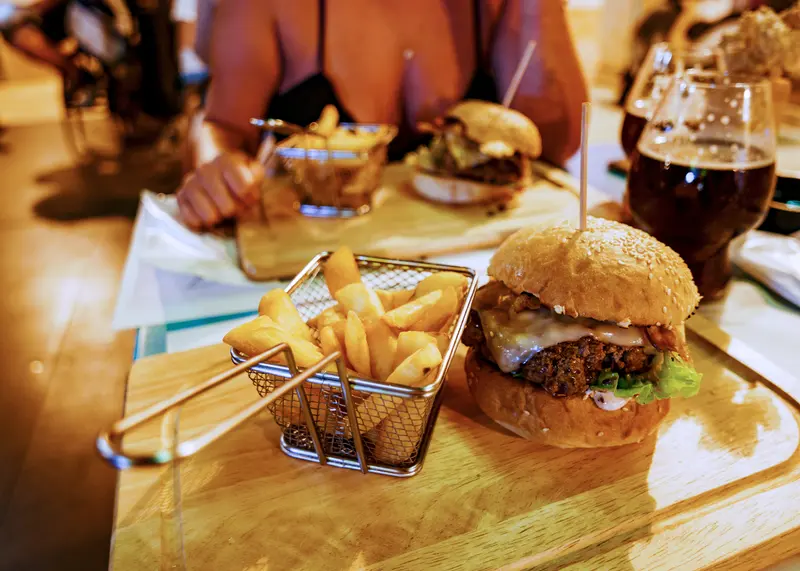
Here is a real calculation for a cheeseburger with fries. Write one like it for every dish on the menu. It takes one evening, and it is one of the most profitable evenings you will spend on the restaurant.
Include everything that leaves the kitchen together with the food. Packaging, napkin and sauce are part of the cost even if they feel almost free.
| Item | Amount | Cost |
|---|---|---|
| Bun | 1 piece | 6 SEK |
| Minced beef | 150 g | 18 SEK |
| Cheese | 1 slice | 3 SEK |
| Lettuce, tomato, onion | Portion | 4 SEK |
| Dressing and pickles | Portion | 3 SEK |
| French fries | 180 g | 7 SEK |
| Packaging and napkin | 1 piece | 3 SEK |
| Total ingredients | 44 SEK | |
| Price excluding moms | 147 SEK | |
| Menu price for takeaway, with 6 percent VAT | 156 SEK |
A short menu beats a long menu
A long menu feels generous but costs money every day. More ingredients in the fridge means more waste, longer cooking times and worse quality in every dish.
Build the menu so the same ingredients are used in several dishes. The chicken in the wrap should also be able to go in the salad and on the plate.
- Eight to fourteen dishes is enough for almost every smaller place
- Let five to six ingredients carry the whole menu
- Remove the three worst selling dishes every quarter. Nobody will miss them.
- Keep one dish that is cheap to cook and that everyone knows. It brings in new guests.
Prices the guest understands
Guests do not compare kronor, they compare feeling. A price of 148 kronor reads as lower than 155, even though the difference is seven kronor. Use that, but do not get silly with prices ending in 99.
Raise prices once a year instead of a little all the time. Many small rises are noticed more than one clear one.
- Set the lunch price after what the offices nearby pay, not after the evening menu
- Drinks have the highest margin. A soft drink that costs 12 kronor and sells for 35 pays for several hours of electricity.
- Offer a meal deal with sides instead of a discount. A meal deal raises the bill, a discount lowers it.
- A children's portion at half price is fair if it is also half the amount
- Put the price on the sign outside. People walk past if they do not know what it costs.
The menu as text and picture
The menu is your most important salesperson, and it is read by people with different levels of Swedish. Short names, clear words and the right price next to them.
If you have a digital menu or an ordering page the same applies: one photo per dish sells more than a long description.
- Write what the dish contains, not how amazing it is
- Mark vegetarian, halal and gluten free clearly if you have it
- You must be able to answer about allergens out loud, even if they are not on the menu
- Take pictures in daylight by the window. A good phone picture beats a bad professional one.
- Update the prices everywhere at the same time: sign, menu, cash register, website and the apps
Common questions
How do I know if a dish is profitable?
Look at two numbers: how many kronor the dish leaves after the ingredients, and how often it sells. A dish that leaves 90 kronor and sells ten times a day is worth more than one that leaves 140 and sells twice.
Should I have the same prices online as in the restaurant?
On your ordering page, yes. In the apps you have to add 10 to 20 percent to cover their fee, otherwise you sell at a loss when you are busiest.
Does a buffet work?
It can work at lunch if you have high volume and control over the waste. Plan for guests to eat for 60 to 70 percent of what they would have ordered à la carte, and the rest ends up in the bin if you do not plan the amounts.
Should I have a menu in several languages?
One short Swedish name and one English name per dish goes a long way. If many guests in your town have another mother tongue, a third language can make a big difference. Pictures often solve more than translations.